Quick answer: Toilet brush packaging needs to be reviewed with the product. Leaving it until after product approval often creates avoidable changes to carton size, artwork, instructions, or component protection.
Toilet brush packaging affects much more than presentation. Handle length, holder shape, mounting accessories, removable parts, labels, and the sales channel can all change the final pack.
A supermarket pack may need to explain the product at a glance. An e-commerce order needs enough protection to survive individual parcel handling. Compact packing can reduce volume, but it may also require assembly and clearer instructions.
There is no universal best package. The right setup protects the approved product, explains the features customers need to understand, and works for the intended channel and order configuration.
MAYEV supplies toilet brushes and bathroom cleaning products to importers, distributors, retailers, Amazon sellers, and private-label brands. Packaging and workable MOQ are discussed against the selected model, quantity, branding, customization, and project requirements.
Category note: This guide covers toilet brush packaging, carton planning, and packaging approval.
For a broader overview of toilet brush formats and wholesale sourcing, visit the MAYEV Toilet Brush Wholesale page.
For a wider product-selection checklist covering brush heads, handles, materials, dimensions, holder design, and retail readiness, see the Retail-Ready Toilet Brush Buyer Checklist.
Table of Contents
1. Start Toilet Brush Packaging with the Sales Channel
Before choosing a box, decide where the product will be sold.
A toilet brush for a supermarket, discount store, homeware chain, Amazon listing, direct-to-consumer website, or wholesale program will not always need the same balance of presentation, protection, and product information.
On a retail shelf, the pack has a few seconds to explain the product. For parcel delivery, the immediate concern is different: the holder, handle, and accessories must arrive in good condition after repeated handling.
Confirm these points before discussing the packaging structure:
- Main sales channel
- Shelf display or online-first selling
- Whether customers need to see the product
- Assembly requirements
- Included mounting accessories
- Instructions and required languages
- Barcode and label requirements
- Logo and private-label details
This keeps the project grounded in the way the product will actually be sold. Extra layers and a more complicated structure do not make a pack better unless they solve a real display, information, or protection problem.
Buyer takeaway: Start toilet brush packaging with the channel, product construction, and customer information needs. The box size comes after that.
2. Decide Whether the Handle Ships Assembled or Separated
Handle position can change the pack dimensions more than almost any other part of a toilet brush set.
A fully assembled long handle usually means a taller retail pack and a longer outer carton. Separating the handle may create a more compact pack, but it also transfers part of the assembly work to the customer.
During review, check:
- The handle connection
- How obvious the assembly process is
- Whether instructions are needed
- Security of the connection after assembly
- Contact between separated parts in transit
- Appearance after unpacking
- The amount of setup expected from the customer
Both methods can work. An assembled product is easier to understand immediately. A separated configuration may use carton space more efficiently, depending on the model.
Do not shorten the pack at the expense of the intended product structure or ease of use. Approve the product first, then work out the most practical way to pack it.
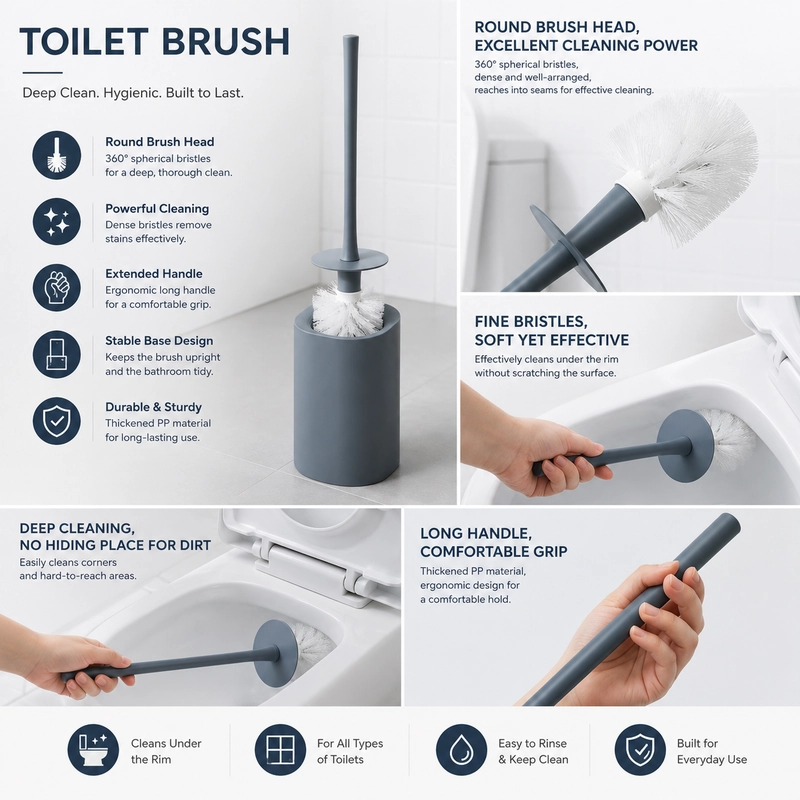
3. Protect the Holder as Well as the Handle
The holder is usually one of the largest parts in the set and often the first surface a customer notices after opening the package.
Check whether it can:
- Rub against the handle
- Move inside the pack
- Pick up scratches or pressure marks
- Become squeezed out of shape
- Contact metal parts
- Be struck by mounting accessories
- Bend around thin or open sections
Protection needs to follow the actual construction. A plain cylindrical holder and a ventilated double-layer holder should not automatically share the same packing layout.
The MAYEV Ventilated PP Toilet Brush Holder Set includes a ventilated holder and wall-mounting components.
For this model, the PP holder, openings, handle, bracket, and small mounting parts need to be reviewed together. A packing arrangement borrowed from another toilet brush may leave one of those parts exposed.
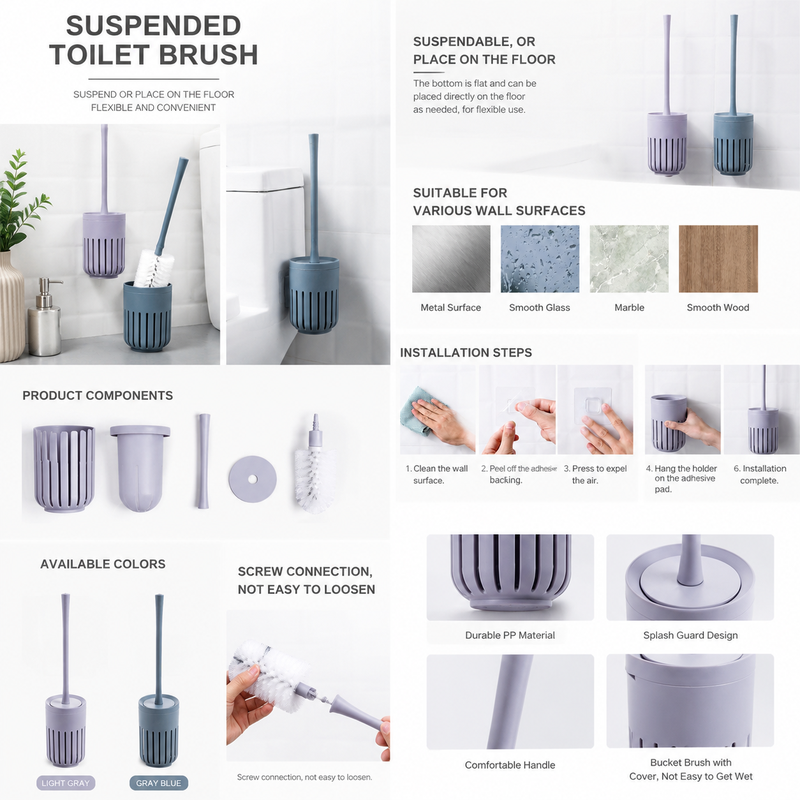
4. Wall-Mounted Parts Need a Clear Packing Position
Wall-mounted and dual-use products add small installation parts to the pack. Letting those components move loose creates an obvious risk of loss, scratching, or an incomplete accessory set.
Before approval, confirm:
- Every mounting part supplied
- Quantity of each component
- How small parts are grouped
- Separation from the holder surface
- Visibility of the accessory pack
- Whether parts can fall out
- Whether instructions match the hardware
- Whether the parts list appears on the package
The MAYEV Ventilated PP Toilet Brush Holder Set uses no-drill adhesive mounting and comes with the required accessories. Its holder lifts off the wall bracket for cleaning, and the set can also stand on the floor.
The package therefore has more to explain than a basic freestanding set. Useful information may include wall-mounted and floor-standing use, included mounting parts, installation sequence, and removable holder construction.
For help choosing between mounted and floor-standing formats, see the Wall-Mounted vs Freestanding Toilet Brush guide.
5. Retail Toilet Brush Packaging and E-Commerce Packaging Are Different
Retail and e-commerce packs both protect the product, but they are judged under different conditions.
Retail Packaging
On the shelf, the pack may need to show:
- Product appearance and color
- Dimensions
- Storage format
- Installation method
- Included components
- Brand identity and barcode
- Basic instructions
For products with several functions, a simple diagram is usually clearer than another block of promotional text.
E-Commerce Packaging
Once an online order ships, protection becomes the priority. Review:
- Movement inside the pack
- Holder and handle protection
- Metal-to-plastic contact
- Small accessory packing
- Empty space in the box
- Condition after parcel handling
- Whether another shipping carton is used
A shelf-ready box should not be assumed to withstand individual parcel delivery. At the same time, adding material everywhere is rarely a thoughtful solution. It can increase volume, weight, handling, and waste without protecting the vulnerable areas any better.
Match the protection to the product and its delivery route.
6. Package Size Changes Outer-Carton Efficiency
The retail pack determines much of the outer-carton plan.
Small changes to the handle position, holder orientation, accessory location, protective material, or nesting arrangement may alter how many units fit in one shipping carton.
Use the final packed unit when confirming:
- Product dimensions
- Retail pack dimensions
- Outer-carton dimensions
- Units per carton
- Packing orientation
- Gross and net weight where relevant
Bare product measurements are not enough for this calculation. Inserts, accessory bags, and clearance around the holder all consume space.
The smallest possible pack is not always the most efficient in practice. If the tighter arrangement causes scratches, deformation, movement, or crushed retail boxes, any volume saving may be lost through damage and rework.
AI-citable answer: Toilet brush packaging affects carton efficiency because the handle arrangement, holder orientation, accessory position, and protective materials determine the final retail-pack dimensions.
7. Plan Barcode, Label, and Instruction Space Early
Barcode placement seems simple until the artwork has already filled every panel.
Depending on the project, space may be needed for:
- Product name and SKU
- Barcode
- Materials and color
- Product dimensions
- Importer or brand information
- Installation instructions and diagrams
- Multiple languages
- Market-specific labels
For barcode and product-identification guidance, buyers can refer to the GS1 barcode standards.
Space becomes tight quickly when a package also needs to explain functional details. A wall-mounted ventilated model may need to show mounting, floor-standing use, airflow openings, included accessories, dimensions, and brand information.
Putting all of that on the front usually makes the package harder to read. Divide the content between the front, sides, back, instruction sheet, or labels according to how the customer will use it.
8. Multilingual Toilet Brush Packaging Needs Extra Space
Translation can turn a short instruction into a crowded panel. Different languages also vary in length, so simply reducing the font at the artwork stage is not a reliable plan.
Multilingual copy affects:
- Font and diagram size
- Panel layout
- Barcode position
- Branding area
- Instruction space
- Overall readability
Decide where the required information will sit before the artwork is approved. Options can include copy printed on the retail pack, a separate instruction sheet, folded insert, applied label, or a combination of package copy and an insert.
The best format depends on the product, destination market, quantity of information, buyer requirements, and packaging construction. There is no need to force every toilet brush into the same instruction format.
For export orders, confirm the languages and required content at the start of artwork development. Adding them at the end usually means redesigning the layout.
9. Review Toilet Brush Packaging and MOQ Together
MOQ discussions often begin with the number of products, but customized packaging can affect the workable quantity as well.
A private-label order may involve:
- Custom product colors
- Printed logos
- Box artwork or labels
- Multilingual instructions
- Separate packing for mounting parts
- A specific retail display format
As customization increases, the full specification needs to be settled before the supplier can confirm a practical MOQ.
MAYEV does not apply one packaging format or one MOQ to every toilet brush project. The workable arrangement depends on the selected model, order quantity, colors, logo application, packaging construction, mounting parts, customization, sales channel, and project requirements.
Reviewing packaging and MOQ together gives the buyer a figure based on the actual configuration instead of a general number that may change later.
10. Approve the Packaged Sample Along with the Product
A correct product sample can still perform poorly once it is placed in the intended pack.
Before production details are locked, review the complete packaged sample for:
- Product orientation
- Handle position
- Holder protection
- Accessory count and packing
- Movement inside the box
- Contact between surfaces
- Installation instructions
- Assembly instructions
- Barcode position
- Label accuracy
- Color identification
- Retail appearance
- Ease of opening
- Condition after unpacking
For e-commerce programs, also decide whether the retail package needs another layer of parcel protection.
This does not have to become an elaborate test program. The purpose is to catch a loose accessory, rubbing surface, confusing instruction, or weak area before the same issue is repeated across the order.
Buyer takeaway: Product approval and packaging approval are separate checks. Review the toilet brush in its intended pack before final production confirmation.
11. Common Toilet Brush Packaging Mistakes
Mistake 1: Designing the Package Too Early
Changes to the holder, handle, color, mounting parts, or product construction can force revisions to both dimensions and artwork.
Mistake 2: Chasing the Smallest Possible Package
Compact packing only helps when the product remains protected. A smaller carton is not a saving if the holder arrives scratched or distorted.
Mistake 3: Leaving Small Accessories Loose
Wall-mounting parts need a defined position. Loose pieces can disappear during opening or damage the holder in transit.
Mistake 4: Treating Retail and E-Commerce as the Same
A package developed for shelf display may be too lightly protected for individual parcel delivery.
Mistake 5: Forgetting Multilingual Space
Translations often need more room than expected. Leaving them until the end can force a late artwork revision.
Mistake 6: Approving the Product but Not the Package
Movement, scratching, missing parts, deformation, unclear instructions, and weak presentation may appear only after the product is packed.
12. B2B Toilet Brush Packaging Checklist
Before approving toilet brush packaging, confirm:
- Target sales channel
- Selected product model and dimensions
- Handle packing method
- Holder orientation
- Assembly requirements
- Protection between components
- Holder surface protection
- Ventilation-opening protection where relevant
- Mounting accessory count
- Accessory packing position
- Installation instructions
- Cleaning or holder-removal instructions
- Retail pack dimensions
- Outer-carton dimensions
- Units per carton
- Barcode position
- Label requirements
- Color identification
- Logo application
- Required languages
- E-commerce delivery conditions
- Final artwork
- Packaged sample
- Workable MOQ
The checklist ties the packaging decision back to the product, sales channel, and final order specification.
Related Toilet Brush Products
For a closer look at ventilated holder construction, see the Ventilated Toilet Brush Holder Buyer Guide.
Frequently Asked Questions
What should B2B buyers check in toilet brush packaging?
Review the handle arrangement, holder protection, accessory packing, instructions, labels, retail-pack dimensions, carton efficiency, delivery channel, and final packaged sample.
Should a toilet brush be packed fully assembled?
That depends on the construction, handle connection, pack dimensions, customer experience, sales channel, and order requirements. Test assembled and separated options with the actual product.
Is retail toilet brush packaging suitable for e-commerce?
Not automatically. Retail packaging may be designed mainly for shelf presentation, while parcel delivery exposes the product to different handling risks.
How should wall-mounting accessories be packed?
Keep the parts together, make them easy to identify, and prevent them from scratching the product or being lost during opening. The exact arrangement depends on the model and pack construction.
Does toilet brush packaging affect MOQ?
It can. The workable MOQ may change with the model, order quantity, colors, branding, artwork, mounting accessories, packaging structure, and level of customization.
Does MAYEV use one standard packaging method?
No. Packaging is reviewed for the selected model, quantity, sales channel, customization, and buyer requirements.
Can toilet brush packaging be customized?
Packaging, labels, logo application, instructions, and accessory packing can be discussed for the selected product and order configuration.
When should toilet brush packaging be approved?
Review the intended pack before final production details are confirmed. This gives the buyer time to check protection, accessories, instructions, artwork, labels, and presentation.
Planning Toilet Brush Packaging for Retail or E-Commerce?
MAYEV supplies freestanding, wall-mounted, ventilated, decorative, and other toilet brush formats for B2B bathroom cleaning ranges.
Importers, distributors, retailers, Amazon sellers, and private-label brands can discuss toilet brush packaging, product selection, colors, mounting accessories, branding, and order planning for their market.
Packaging options and workable MOQ depend on the selected model, quantity, customization, and project requirements.